
Transform Your Decision Making

The Next Industrial Revolution Is Not About Machines. It Is About How Decisions Get Made.

AI, data, and automation are pushing organizations beyond reporting and dashboards toward continuous, action-oriented decision making.

Playbooks sit at the center of this shift by turning insight into action and data into an operational asset.

Accounts Receivable Performance Playbook
Edit
Playbook
Chart 1

Narrative

1. Grade

Overall AR Cash Quality and Driver Scores

AR Cash Score: 80 (B-)

Solid but improvable AR performance; strong aging quality and collections offset by slower-than-ideal time to cash and customer concentration risk.

Turnover Score: 82

AR turns about 7.0x per year, converting roughly $138.48M of net billings through a $19.72M receivables base.

Time To Payment Score: 75

Average time to payment is about 52.0 days, longer than typical 30-45 day targets for a wholesale business.

Aging Score: 92

Only about 2.1% of total open AR sits in the 90+ day bucket, and expected losses on overdue AR are roughly 1.0% of the AR balance.

Expected Cash Collections Score: 80

Of $19.72M open AR, approximately $19.52M is expected to convert to cash based on observed default probabilities; cash sales are negligible in this model.

DSO Score: 78

DSO at ~52 days is acceptable but leaves meaningful room to release $2-3M of working capital by moving closer to mid-40s.

Concentration Score: 65

The top 5 overdue customers hold ~41.0% of overdue exposure (~$2.27M), indicating moderate but manageable concentration risk.

Insight to Action, Built For How You Operate

Playbooks are intelligent, action-oriented guides that explain what's happening, why it's happening, and exactly what to do next embedded directly into your operations.

Product Performance Playbook
Edit
Playbook
Table 1
Chart 1

Playbook

Product Performance & Margin Optimisation

Strategic playbook for pricing, margin and portfolio decisions

Narrative

Executive Product Performance Snapshot

High-level view of revenue, margin, volume and emerging risk signals

Portfolio scale and economics

Net revenue of £7.2M across 10,632 units with total discounts of £171K (2.3%). eBikes and Touring Bikes are the dominant revenue contributors, making up around 65% of unit volume.

Performance concentration versus breadth

Top 10 products account for approximately 73% of total revenue. The top 25 cover ~58% of net sales. Portfolio performance is heavily concentrated in a narrow set of high-performing SKUs.

Category mix and margin structure

eBikes, Touring Bikes, and BMX account for over 85% of net revenue. Other items and accessories make up 5.8%. Average post-discount margin is 36.7%; 3 categories are flagged below 20%.

Trend scan: growth arbitrage material

Growth-rate analysis surfaces 2 categories where revenue growth is outpacing margin erosion. One underperformer shows early rebound signals worth monitoring next quarter.

Early indicators of margin pressure

Discount depth has increased 0.4pp quarter-on-quarter for 3 consecutive quarters in the eBike segment. Price variance across channels for identical SKUs is 3.2%.

Risk signals and margin pressure

BMX and accessories carry the highest discount rates at 4.1%. Price variance across identical SKUs indicates inconsistent trade terms in 2 channels.

Top and Bottom Performing Products

Ranked view of key products by revenue, margin, volume and discount sensitivity

Product
Product Type
Performance
Sentiment
Risk Score
Margin %
Hybrid Pro 28″
eBike
12
41.2%
Mountain Trail X
Mountain
18
38.7%
City Cruiser EL
Urban
15
36.1%
eBike Sport 21″
eBike
22
34.8%
Touring Elite LT
Touring
20
33.5%
CycleCross Pro
Cross
65
18.2%
Urban Lite
Urban
72
15.4%
BMX Street Pro
BMX
78
12.1%

Top performer is priced at a 14% premium to category average with stable year-on-year volume.

Highest overall margin achieved by Hybrid Pro 28\u2033 at 41.2% post-discount, with lowest risk score in portfolio.

Bottom 3 SKUs collectively represent 8.4% of revenue but consume 22% of total discount spend.

Visualisation

Product Performance by Customer Sentiment Proxy

Track customer reviews and negative returns and leverage as a commercial health indicator

806040200
Hybrid Pro
Mountain X
City Cruiser
eBike Sport
Touring Elite
CycleCross
Urban Lite
BMX Street
Pos. Sentiment %
Neg. Sentiment %

High volume, generally healthy accounts

The top 4 products by volume show consistently positive review patterns and low return rates, reinforcing their role as portfolio anchors.

Concentrated dissatisfaction hot spots

CycleCross and Urban Lite account for 62% of all negative sentiment, despite representing only 8% of total unit volume. Warranty claim frequency is 3.2x the portfolio average.

Subtle, promotional unknown

BMX Street and Touring Elite show divergent patterns: promotional pricing boosts volume but also drives return rates, obscuring true product-market satisfaction signals.

Narrative

Where Margin Is Won and Lost

Thematic view of product and category-level margin dynamics

Best margin products: what they have in common

Premium positioning with low discount dependency; average discount rate of 1.2% versus portfolio average of 2.3%.

Consistent cross-channel pricing with variance under 1%, suggesting strong trade terms and disciplined execution.

High attach rates for accessories and add-ons, driving incremental margin without additional acquisition cost.

Customer retention rates above 72%, reducing the cost-to-serve and improving lifetime margin contribution.

Strong brand sentiment (NPS 68+) correlating with lower price sensitivity and higher willingness to pay.

Worst margin products: what they have in common

Heavy reliance on structured discounts; average discount rate of 4.1% with some SKUs exceeding 6%.

Channel conflict: the same SKU is priced 3.2% differently across direct and wholesale channels.

High return rates (8.4% vs. portfolio average of 2.1%) eroding gross margin by an estimated 1.8pp.

Low repeat purchase rates (under 15%), indicating limited brand loyalty and high customer churn.

Margin compression accelerating: 0.4pp decline quarter-on-quarter for 3 consecutive quarters.

Narrative

Pricing and Discount Strategy Opportunities

What to tighten, where to relax, and where to experiment

Tighten discount governance on high-margin, under-discounted products

Hybrid Pro and Mountain Trail X have margin headroom of 5-8pp above category average. Restrict discretionary discounting to preserve premium positioning.

Reduce structured discounting on discount-heavy segments

BMX and CycleCross segments absorb 38% of total discount spend while contributing only 12% of revenue. Renegotiate trade terms and cap promotional allowances.

Protect the hybrid and Cruiser range framework

The eBike and Cruiser ranges collectively contribute 54% of gross margin. Prioritise consistent pricing across channels and limit cross-promotional bundling.

Product Portfolio Actions for Leadership

Priorities and assignments to protect and double down on

1

Protect the top 5 SKUs by maintaining pricing discipline; these products contribute 52% of total portfolio margin and should not be used as promotional vehicles.

2

Initiate SKU-level P&L review for CycleCross, Urban Lite, and BMX Street Pro to determine whether margin recovery is feasible or portfolio pruning is required.

3

Cap aggregate discount spend at current levels (2.3% of net revenue). Any increase requires VP-level approval with documented business justification.

4

Launch A/B pricing test on Touring Elite in 2 test channels to quantify price elasticity before committing to range-wide changes.

5

Commission channel-level margin waterfall analysis to identify exactly where and how the 3.2% price variance is occurring.

6

Set 90-day review cadence for margin KPIs: track discount depth, channel variance, and return rates monthly.

7

Investigate operational root causes behind the 3.2x warranty claim rate on underperforming SKUs.

8

Evaluate near-term sourcing alternatives for components in tariff-affected SKUs, with focus on maintaining quality standards.

9

Align sales incentive structures: decouple volume bonuses from discount-heavy products to reduce margin-dilutive selling behaviour.

10

Create product portfolio dashboard with real-time margin waterfall, discount tracking, and sentiment overlay for leadership visibility.

Go beyond dashboards and reports

Move past static views of what happened and deliver context, explanation, and recommended actions when they matter.

Designed for leaders and frontline teams

Findings become a short, ranked focus list. Each item states the issue, a working hypothesis, and a suggested next move with supporting views for validation.

Powered by data, AI, and business context

Actions and results are reviewed on a regular cadence. Lessons feed back into future recommendations so priorities sharpen over time.

THE PROBLEMS PLAYBOOKS SOLVE

Why Reports and Dashboards Are No Longer Enough

Traditional reporting tells you what happened but leaves teams guessing why it happened and what action to take.

Backward-looking, static insights

Insights arrive after the fact, reflecting past performance rather than current reality.

Decisions trapped at senior levels

Information concentrates at the top, limiting the ability of teams closest to the work to act.

Heavy reliance on analysts and reporting specialists

Business questions must pass through specialist teams, slowing access and creating bottlenecks.

Insight without accountability or action

Findings are observed but not owned, leaving no clear path from insight to execution.

Reimagining How Decisions Are Made Across Your Organization

Playbooks decentralize decision making by putting context, explanation, and recommended actions directly in the hands of the people who need them.

Shift from "informing" to "enabling action"

Move beyond delivering information and focus on enabling timely, confident action across the business.

Create consistency in how problems are identified and resolved

Standardize how issues are detected, analyzed, and addressed to reduce variability and risk.

Financial Snapshot
Playbook
Chart 1

Narrative

1. Financial Snapshot

Mitigating Tariff Impact
Playbook
Chart 1

Risk Assessment

1. Exposure

Accounts Receivable Performance
Playbook
Chart 1

Narrative

1. Grade

The Next Quarter

Jan
Feb
Mar

Top Takeaways

Aging mix improved 12%

DSO reduced by 4 days

Top 10 accounts on track

Cash Improvement Plan
Playbook
Chart 1

Data Story

$150,000 Cash Improvement Plan

$63,530
Day 35

How to win

Focus on Deferment

Enhanced Payment Terms

Enforce Discount Terms

Improve Discipline

Empower frontline teams with clarity and confidence

Equip teams with clear context and recommended actions so they can act decisively.

Flatten management layers without losing control

Distribute decision making closer to the work while maintaining governance and oversight.

Focus leadership on decisions, not dashboards.

Playbooks in action

From leadership teams to frontline operators, Playbooks empower you to adapt to how your business runs.

Operational Performance Management

Identify issues early, understand root causes, and act fast.

Revenue & Margin Optimization instant answers

Spot leakage, explain variance, and guide corrective actions.

Customer Experience & Retention

Understand what's driving churn and what teams should do next.

Connect with customers

Solve a problem or close a sale in real-time with chat. If no one is available, customers are seamlessly routed to email without confusion.

Executive resources

Accounts Payable Playbook 90 second overview

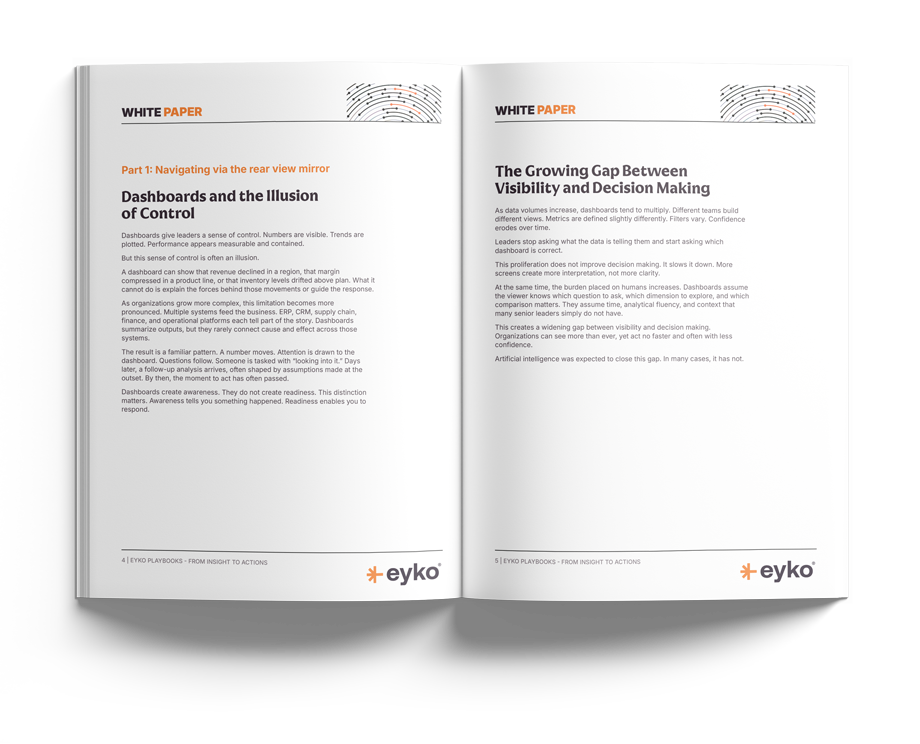
White Paper: From Insights to Actions

White Paper: From Insights to Actions

Download PDF
Why Leaders Are Rethinking Dashboards

Why Leaders Are Rethinking Dashboards

Read Article

Ready to build your first Playbook?

Join the enterprises replacing weeks of manual analysis with a single prompt. See what eyko Playbooks can do with your data.

Explore eyko Beats