Published 10 Sep 2026
Have you outgrown your JD Edwards reporting?
JD EdwardsDecision IntelligenceReporting

Published 10 Sep 2026
Your JD Edwards reporting tool was the right call when you bought it. JDE was the system, the reports came out of the system, and that was the job done.
What changed is everything around it.
JDE is still the backbone. It still runs finance, still runs operations, still holds the transactions that matter. But the business now also runs on a CRM, a separate HR system, a planning tool, a warehouse system, and usually something inherited from an acquisition that nobody has consolidated yet. The reporting tool kept doing exactly what it always did. The questions stopped fitting inside one system.
That is the point where JDE customers start to wonder whether the problem is the tool. Usually it isn't. The tool is fine. It has just been asked to do a job it was never scoped for.
Here are the three signs I hear most often.
Take a customer who has slipped from paying in 30 days to paying in 55.
In JDE you can see it clearly. The invoices, the aging, the payment history, the credit notes that went out along the way, all right there. What JDE cannot show you next to that is the run of tickets in your service desk, the renewal your account manager has been quietly chasing in the CRM, or the delivery complaints that have been going to a shared mailbox for two months.
The numbers are in JDE. The explanation is in the systems around it. So somebody exports.
The extract is the tell. Once the report becomes a starting point rather than an answer, the real analysis has moved into a spreadsheet, and so has the business logic.
That has consequences beyond the time it takes. The logic now lives in a file on somebody's laptop. It gets copied, edited, and renamed until there are four versions and one of them is called FINAL. When a director asks a follow up question, the answer depends on whoever built the workbook being available and remembering what they did.
Reports were supposed to remove that dependency. For a lot of JDE customers they have quietly reintroduced it.
This one is the most expensive and the least visible, because nothing has failed.
The report works. It shows that margin moved. Then the actual work starts. Which products, which regions, which customers, is it price or cost or mix, who owns it, what do we do about it. That is a week of meetings, emails, and more extracts. By the time the decision gets made, the thing you were deciding about has moved again.
Nobody puts that in a business case, because there is no line item for it. It just shows up as a finance team that always feels one period behind.
Reporting did not get worse. It solved the problem it was built for, which was showing you what is happening in your business.
Getting the number out of the ERP used to be the hard part, and a generation of tools got genuinely good at solving it. BI Publisher, One View, third party report writers, the products I built earlier in my career. All of them were built to answer one question: what happened. Most of them answer it well.
The hard part now is why it happened and what to do next. No reporting tool was built for that, because it was never the brief. The margin report will tell you margin fell, accurately and to two decimal places. It will not tell you that most of the drop sits with two customers who moved onto a lower price list after a service issue, because half of that story is in your CRM.
Cost variance works the same way. The report shows the unfavorable number against standard, correctly. Whether that is a supplier price increase, a freight surcharge, or a buyer switching source mid quarter sits across purchasing records, freight invoices, and whatever the buyer knows and has not written down anywhere.
This is what eyko Playbooks do. They sit above your reports rather than in place of them.
A Playbook starts from a question or a change worth explaining, works across JDE and whatever else your business runs on, and comes back with what happened, why it happened, the evidence behind that reasoning, and what to consider doing next. Not a chart to interpret. A structured briefing you can argue with, because the workings are shown.
Two things matter for JDE customers specifically. eyko connects directly to your systems, so there is no warehouse project standing between you and the first useful answer. A warehouse is a bonus if you have one, not an entry requirement. And eyko works with your data as it actually is, including the account structures, the category codes, and the twenty years of local conventions that make your JDE instance yours.
Worth being clear about what none of this means. Your period end pack is fine. The financial statements your auditors want in a specific format are fine. The operational report someone checks at 7am every morning is fine.
None of that is the problem, and none of it has to be rebuilt to close the gap between spotting something and acting on it. What you add matters more than what you replace.
If you want this from someone with more JDE mileage than most of us, John Brooks hosted a 30 minute session on it on September 24. The recording is available on demand.
John was one of the first employees at JD Edwards Europe in the early 1990s and has spent more than 30 years in JD Edwards reporting and analytics, including 22 years at insightsoftware. He has worked with JDE customers across North America, the UK, and Europe on how they report, analyze, and act on ERP data. He has seen reporting projects in this space succeed, fail, and get quietly replaced by a spreadsheet.
He covers the three reasons JDE customers reach this point, and then the part I can't write for him: which responses he has watched actually work, which ones looked right on paper and stalled, and where he draws the line between what your reporting should keep doing and what it was never built to do.
It is aimed at finance directors, finance managers, controllers, and FP&A teams working with JD Edwards, plus the reporting and BI people who build for them. Any reporting tool, on premise or cloud.
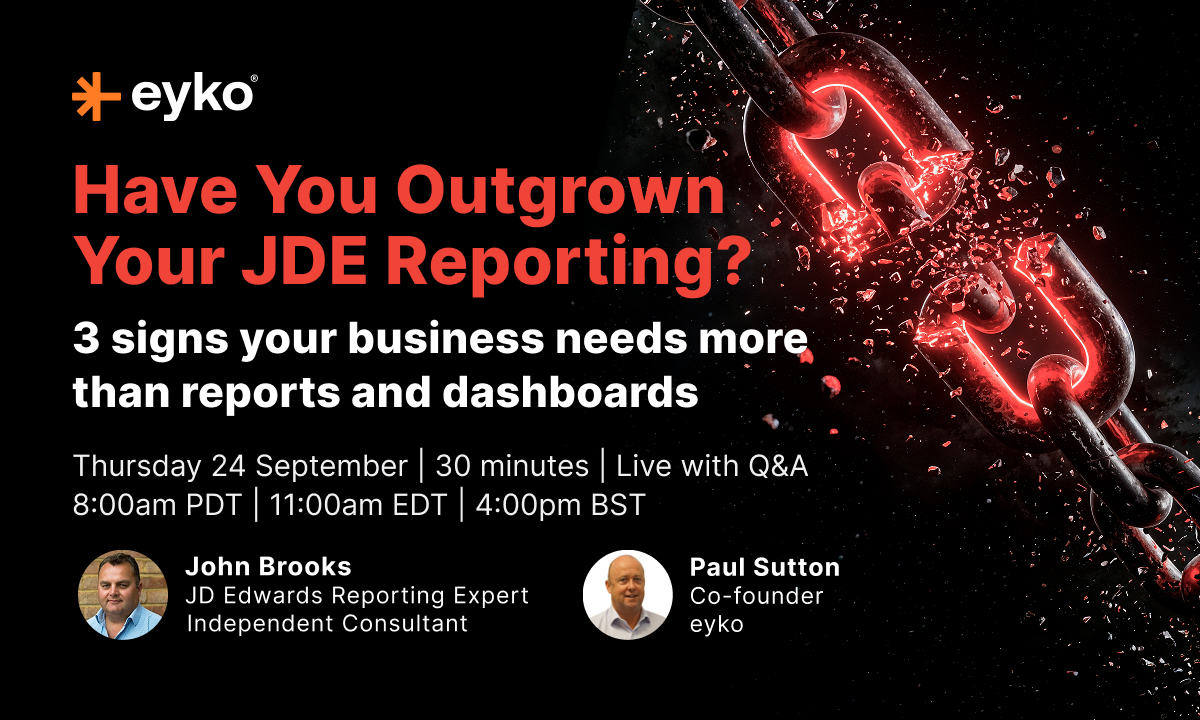
Have You Outgrown Your JDE Reporting? Recorded September 24, 30 minutes. Watch the recording.
New to the category? Learn what decision intelligence is and why it changes how teams act on data.

Vice President, Product Marketing
10 Sep 2026
Mark Hudson is VP of Product Marketing at eyko, where he leads positioning, content, and go-to-market execution for eyko Beats and the Decision Intelligence category. He founded and successfully exited two analytics companies, Antivia (acquired by insightsoftware) and Blue Edge Software (acquired by SAP BusinessObjects). His focus is helping decision-makers move past dashboards and reports to deliver action-based outcomes that drive better decisions.
JDE reporting covers the tools and processes JD Edwards customers use to get information out of the ERP, including embedded options like BI Publisher and One View Reporting, plus third party report writers and analytics products built for JDE. These tools are designed to answer what happened inside JD Edwards.
Usually because the business grew past the ERP. When core processes run across JDE plus a CRM, an HR system, and a planning tool, no single system report covers the whole question. The reporting tool still works, but users start exporting to spreadsheets to combine data and finish the analysis by hand.
Yes. eyko sits above existing reporting rather than replacing it. Statutory reports, period end packs, and operational reports can stay exactly where they are. eyko adds the cross system analysis and recommendations those tools were not built to produce.
No. eyko connects directly to JD Edwards and to your other business systems, so you can get answers across systems without a warehouse project first. If you already have a warehouse, eyko can use it. It is not a prerequisite.
JDE reporting tells you what happened inside JD Edwards. Decision intelligence explains why it happened across all of your systems and recommends what to do next, with the evidence behind that reasoning. Reporting is the input. The decision is the output.
The latest industry news, interviews, technologies, and resources.

I built Hubble Reporting for JD Edwards and over 1,000 customers used it to get faster answers to what happened. It never got them to why, or what to do next. That gap is why I started eyko.
Read post

The case I would put in front of a board: five measurable components, five published benchmarks, and why decision intelligence and consulting solve different problems.
Read post
I named a product DecisionPoint and it never helped anyone decide anything. It just showed them, faster, where things were already going wrong. Paul Sutton and I are running a live session on what actually closes that last stretch.
Read post