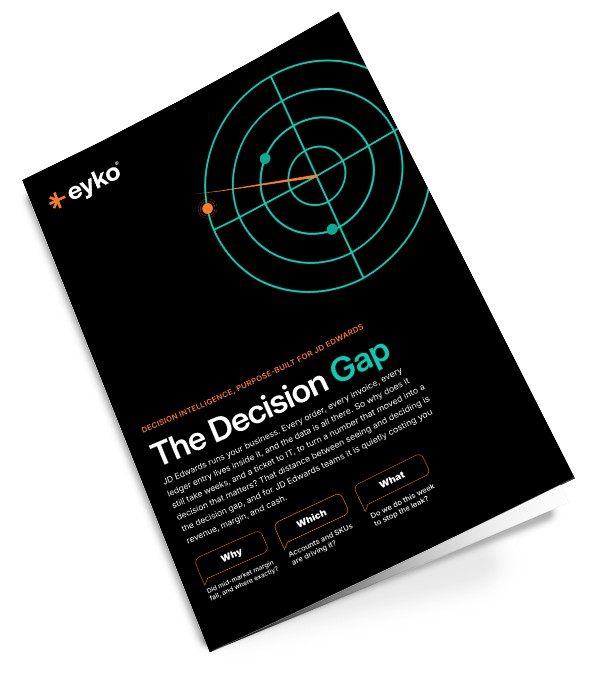
Decision Intelligence for JDE
JD Edwards runs your business, but turning a number that moved into a decision still takes weeks of analyst time. The time between seeing and deciding is the Decision Gap, and every day it stays open it costs you revenue, margin, and cash.
Imagine asking your JD Edwards data anything in plain business language
Cryptic table and field names resolved from the JD Edwards data dictionary.

The problem
Signals in your business
Reports track what someone decided was worth tracking. The signals that hurt you most are the ones no one thought to chart, invisible until they surface as a crisis: the customer that already churned, the margin that already eroded, the cash that already left.
Critical data lives across hundreds of tables with names like F0911 and F4211, and fields coded DCTO, KCOO, and AN8. Answering one cross-functional question needs deep technical knowledge or a queue for IT, so decisions slow and every team reads the numbers differently.
Even for the signals you do see, the response is slow. Someone notices a metric, opens a spreadsheet, schedules a meeting, asks an analyst, and waits. Weeks pass between signal and action, and the window to do something has often closed first.
With eyko, the same signal arrives already explained, in business language, with recommended actions attached.
Signal to decision, the same day.
The solution
BI stops at What. eyko tells you Why, and What Next.
You don't run your business on JD Edwards alone. eyko brings your JD Edwards data together with the systems around it, Salesforce, HubSpot, NetSuite, and aligns them with no data warehouse and no integration project. Questions you can answer in minutes, not weeks:
Most analytics vendors treat JD Edwards as a migration waiting to happen. eyko treats it as the priority. JD Edwards first, by design.
Conversations
Because eyko already understands the JD Edwards context, anyone can ask a question in plain business language and get an accurate answer in seconds, even across systems.
What is our average time-to-cash for Q1?
Average time-to-cash for Q1 was 47 days, up 6 from Q4. The increase is concentrated in two business units where credit holds released late.
Illustrative example. eyko answers from your live JD Edwards data.
Works with what you run
Stay on the JD Edwards you already run. eyko does not require you to migrate to a new ERP to get value, and it does not push you toward one.
eyko sits on top of your existing systems and reporting strategy. Your dashboards, reports, and Business Intelligence keep working; eyko adds the why and the what next on top.
No multi-year data project. eyko works with the data already in JD Edwards and connects to other systems when you want a cross-system view. Value starts now, not after a rebuild.
eyko complements Business Intelligence, it does not replace it. BI shows what happened; eyko explains why, and recommends what to do next.
Enterprise ready
eyko uses role-based access that integrates with your identity provider, so people see only the data they are entitled to see.
Metrics, business terms, and hierarchies are defined once and applied consistently, so there is a single source of truth across every team.
Data is encrypted in transit and at rest, and access follows least-privilege principles.
Every connection, question, and Playbook is logged, so you can show who accessed what, and when.

eyko is SOC 2 aligned, with your data governed by your rules.
The business case
Caught while it is forming, not after it has landed.
Stopped while it is happening, not found at close.
Pricing and cost anomalies surfaced across accounts and SKUs.
Working capital defended across Order-to-Cash and Source-to-Pay, with faster time-to-cash.
FAQ
Yes. eyko reads across JD Edwards and the other systems your business runs on, and treats them as one analytical surface. You can ask a question that spans JD Edwards and your CRM or other sources and get a single answer, without assembling it by hand in Excel.
No. There is no data warehouse to stand up and no ETL project to fund. eyko connects to JD Edwards via ODBC or JDBC against the underlying database, or via file-based import from UBE outputs and saved extracts. Most teams run their first Playbook within 30 minutes of connecting.
No. eyko sits above JD Edwards as a decision layer. Your JD Edwards keeps running your finance, distribution, manufacturing, and projects exactly as it does today. There is no migration and no re-platform.
Yes. eyko sits on top of JD Edwards and does not replace your existing reports or Business Intelligence. They keep working, and eyko adds the why and the what next on top.
eyko has the JD Edwards data dictionary built in, across both World and EnterpriseOne. It translates cryptic table names like F0911 and field codes like AN8 into business terms such as General Ledger and Customer, and handles the joins between modules for you.
Yes. eyko honors the roles and permissions you already maintain in JD Edwards, encrypts data in transit and at rest, and keeps every connection, question, and Playbook auditable. eyko is SOC 2 aligned.
Fast. There is no multi-month project and no data readiness phase to clear first. Most teams connect and run their first Playbook the same day, and see a real insight on day one rather than day ninety.
Connect JD Edwards, ask your first question in plain business language, and get your first Playbook. Most teams see the What, the Why, and the What Next from their live data within 24 hours.